Mobile wallets are rapidly evolving beyond simple payment applications and are becoming a critical layer of global payments infrastructure. According to insights shared by cross-border payments provider Thunes, wallet-based payouts are increasingly reshaping how international funds are sent, received, and spent worldwide.
Mobile wallets are rapidly evolving from simple payment applications into one of the most important infrastructure layers in the global payments ecosystem.
With billions of active wallet accounts worldwide, digital wallets are increasingly becoming the primary financial access point for consumers, businesses, freelancers, and gig workers across both developed and emerging markets.
This shift is changing how cross-border payments are sent, received, and spent, forcing banks, payment providers, and money transfer operators to rethink traditional payout models built around bank accounts.
In many regions, smartphones have effectively become the main gateway to financial services. Beyond payments, wallets are now used for salary disbursements, remittances, merchant transactions, savings, insurance products, and ecommerce purchases. As adoption continues to accelerate, wallet connectivity is becoming as strategically important as traditional banking infrastructure.
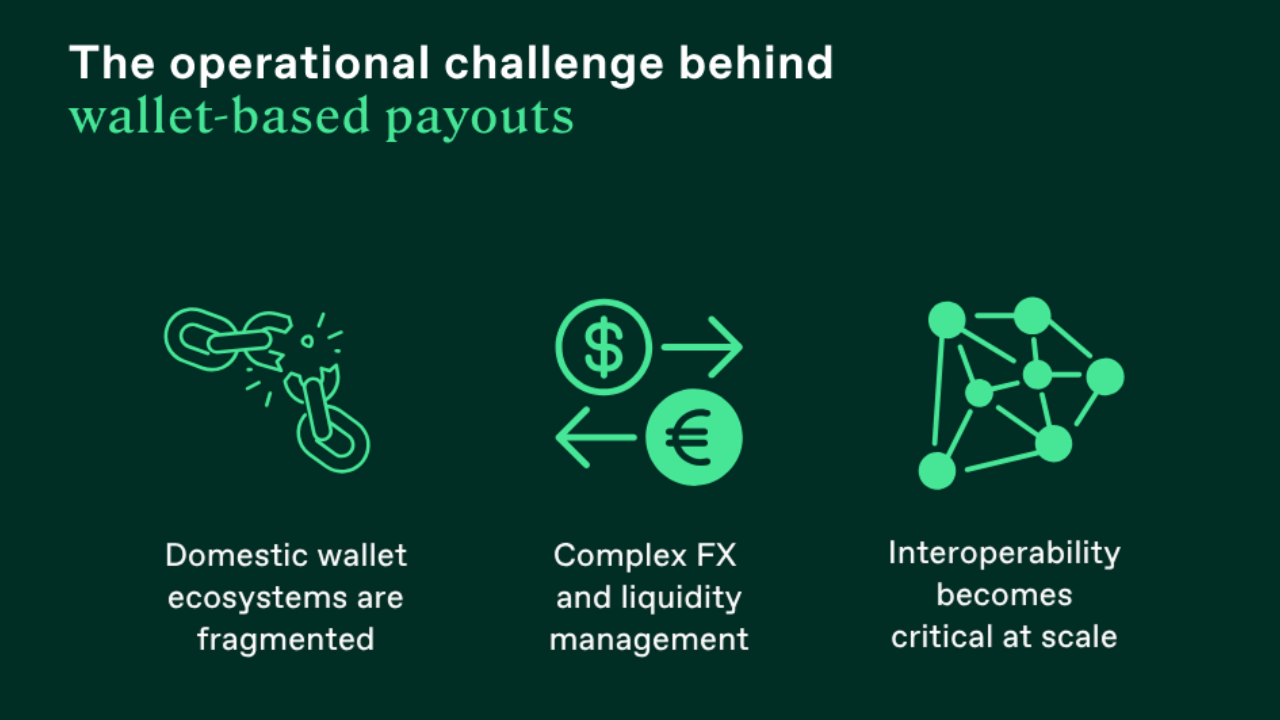
However, the rapid growth of wallet ecosystems has introduced new infrastructure challenges. Unlike banking networks, wallet providers have emerged through a mix of fintech companies, telecommunications operators, neobanks, and local payment schemes, creating significant fragmentation across markets.
Payment providers seeking global reach must navigate different integration standards, settlement requirements, foreign exchange processes, compliance frameworks, and regulatory obligations. Building and maintaining direct connections to hundreds of wallet providers can be both costly and operationally complex.
As a result, interoperability is emerging as one of the most important battlegrounds in the future of payments.
Infrastructure providers are increasingly building network-based connectivity layers that link wallets, bank accounts, payment schemes, and local clearing systems through a single integration. These platforms enable payment providers to route transactions through the most appropriate local payout method without managing multiple direct integrations.
Key capabilities include automated foreign exchange management, centralized liquidity infrastructure, embedded compliance controls, multi-rail payment routing, and wallet-to-wallet connectivity across borders. The objective is to simplify international money movement while allowing recipients to receive funds through their preferred financial channel.
The rise of mobile wallets reflects a broader shift toward wallet-first finance, where consumers increasingly interact with financial services through mobile applications rather than traditional banking channels.
Looking ahead, the next phase of innovation is expected to focus on deeper interoperability between wallets, banks, instant payment networks, and blockchain-based settlement systems. Stablecoin-powered wallet payments, real-time cross-border settlement, and embedded financial services are likely to play an increasingly important role in the evolution of global payments infrastructure.
For banks, fintech firms, and payment providers, the challenge is no longer simply moving funds across borders. The challenge is ensuring those funds arrive directly within the financial ecosystems where consumers and businesses already manage their daily financial lives.