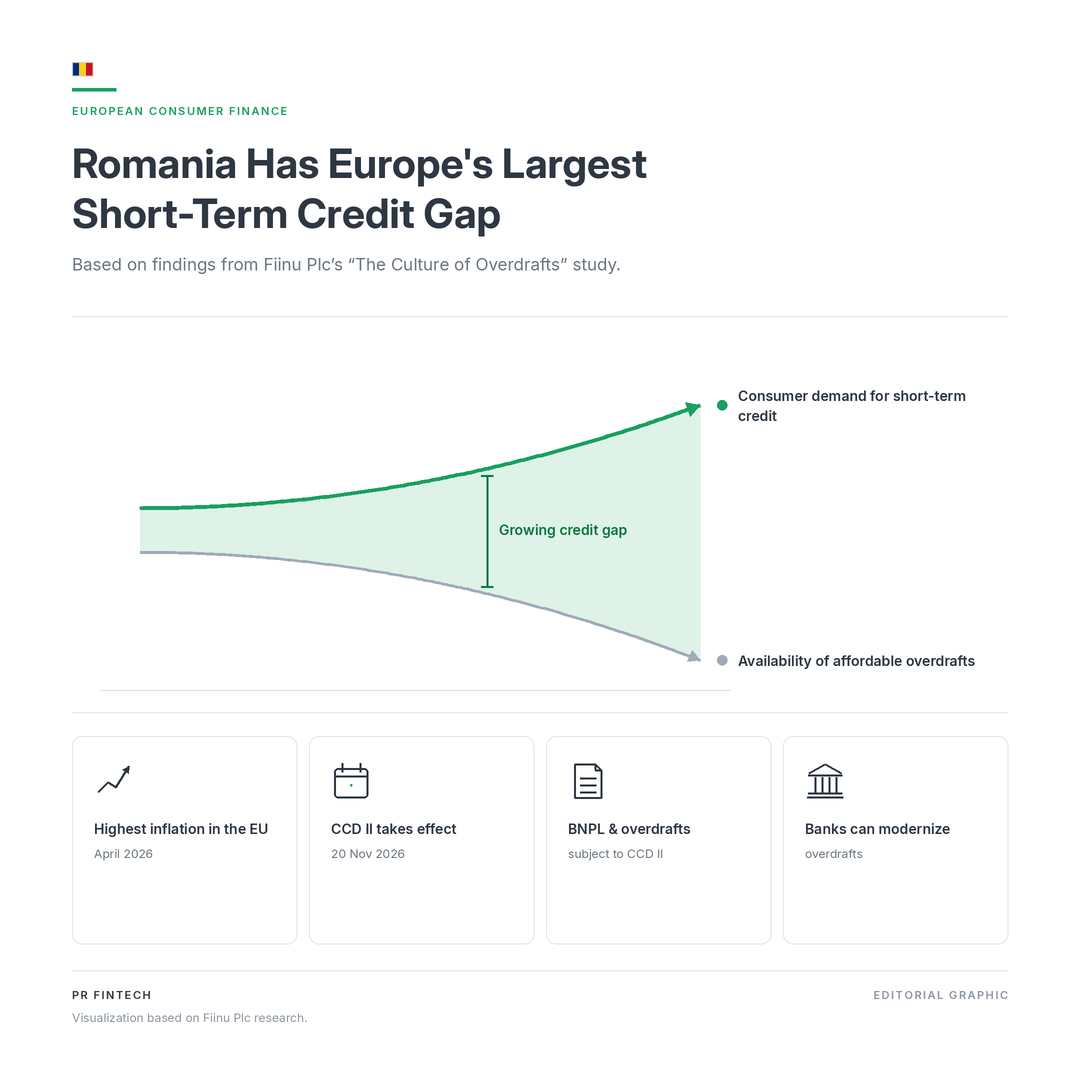
Romania has the widest gap between consumer demand for short-term credit and the availability of affordable overdraft products in Europe, according to a new study published by London-listed fintech Fiinu Plc.

The report, The Culture of Overdrafts, examines short-term borrowing markets across the European Union, the European Economic Area, the United Kingdom, and Switzerland. Its findings identify Romania as one of the continent’s most underserved markets for short-term credit at a time when new European regulations are set to reshape consumer lending.
The research comes just months before the revised Consumer Credit Directive (CCD II) takes effect across the European Union on 20 November 2026, introducing stricter rules for overdrafts and Buy Now, Pay Later (BNPL) products.
Demand for short-term credit continues to outpace supply
According to Fiinu’s research, Romania combines several structural factors that continue to drive demand for flexible short-term borrowing.
The country currently records the highest inflation rate in the European Union, while many households continue to face rising living costs. At the same time, younger consumers have become increasingly comfortable using short-term credit to manage everyday expenses.
Despite this growing demand, the study argues that affordable overdraft products have gradually become less accessible, creating a widening gap between consumers’ financial needs and the products offered by traditional banks.
Rather than relying on overdrafts, many Romanian consumers have increasingly turned to installment loans and online lending platforms to bridge short-term liquidity needs.
New EU rules could reshape the overdraft market
A key focus of the report is the implementation of the revised Consumer Credit Directive (CCD II), which will introduce a more consistent regulatory framework for short-term lending across Europe.
From November, overdrafts and Buy Now, Pay Later products will be subject to many of the same consumer protection requirements as traditional loans. Among the new obligations, banks will be expected to monitor customers who remain overdrawn for extended periods and proactively recommend more appropriate credit products where necessary.
Fiinu believes these changes could significantly alter the competitive landscape by increasing compliance requirements while encouraging banks to redesign overdraft products for today’s borrowing habits.
Romanian banks face a strategic opportunity
The study identifies Romania as one of the European markets where banks have the greatest opportunity to modernize short-term lending.
According to Fiinu, several of the country’s largest retail banks—including Banca Transilvania, Banca Comercială Română (BCR), BRD Groupe Société Générale, ING Bank Romania, Raiffeisen Bank Romania, and UniCredit Bank Romania—have increasingly focused on installment lending and other consumer credit products, leaving overdrafts as a relatively secondary offering.
Commenting on the findings, Dr. Marko Sjoblom, Founder and CEO of Fiinu Plc, said Romania represents one of the clearest examples of a market where consumer demand has outgrown existing overdraft products.
“Romania is the clearest case in Europe of a country where the need for a short-term cushion is real and rising, and where the traditional overdraft no longer meets it. Inflation, a young population growing comfortable with borrowing, and high poverty rates together create a significant opportunity for banks willing to rethink the product,” he said.
Dr. Sjoblom also noted that installment lenders and online credit providers have increasingly filled the gap left by traditional overdrafts but will soon face the same regulatory framework under CCD II.
A broader shift across European consumer lending
While Romania ranks highest in Fiinu’s analysis, the report suggests the underlying trend extends across much of Europe.
Higher living costs, changing consumer borrowing habits, and tighter regulatory oversight are reshaping demand for short-term credit products. At the same time, banks and fintech companies are being challenged to develop lending solutions that balance affordability, responsible lending, and regulatory compliance.
For financial institutions, the report highlights an opportunity to rethink overdrafts as part of a broader strategy to improve customer access to flexible short-term financing.
Study Availability
The full The Culture of Overdrafts report, together with Fiinu’s dedicated Romania country brief, is available upon request from the company.
About Fiinu
Fiinu Plc (AIM: BANK) is a London-listed fintech company founded in 2017 that develops Plugin Overdraft®, a bank-independent overdraft platform designed to allow customers to access overdraft facilities alongside their existing current account without switching banks.
The platform combines Open Banking with AI-powered affordability assessments to make real-time lending decisions and is designed to integrate with existing banking infrastructure without requiring changes to banks’ core systems.
According to the company, the technology can technically connect to more than 100 million personal current accounts in the United Kingdom and approximately 95% of bank accounts across the European Union.
Fiinu developed Plugin Overdraft® after regulatory reforms in the UK significantly reduced access to traditional overdraft facilities, creating what the company estimates to be a £10 billion market opportunity. In 2025, Fiinu entered an exclusive strategic partnership with Conister Bank Limited, part of Manx Financial Group Plc, to launch the solution in the UK.
The company is led by founder and Chief Executive Officer Dr. Marko Sjoblom.