Emerging-market borrowers are facing mounting pressure as higher global interest rates, wider credit spreads, and volatile currency markets reshape international funding conditions. India’s offshore debt slowdown highlights how rising hedging costs are increasingly reducing the appeal of dollar-denominated borrowing.
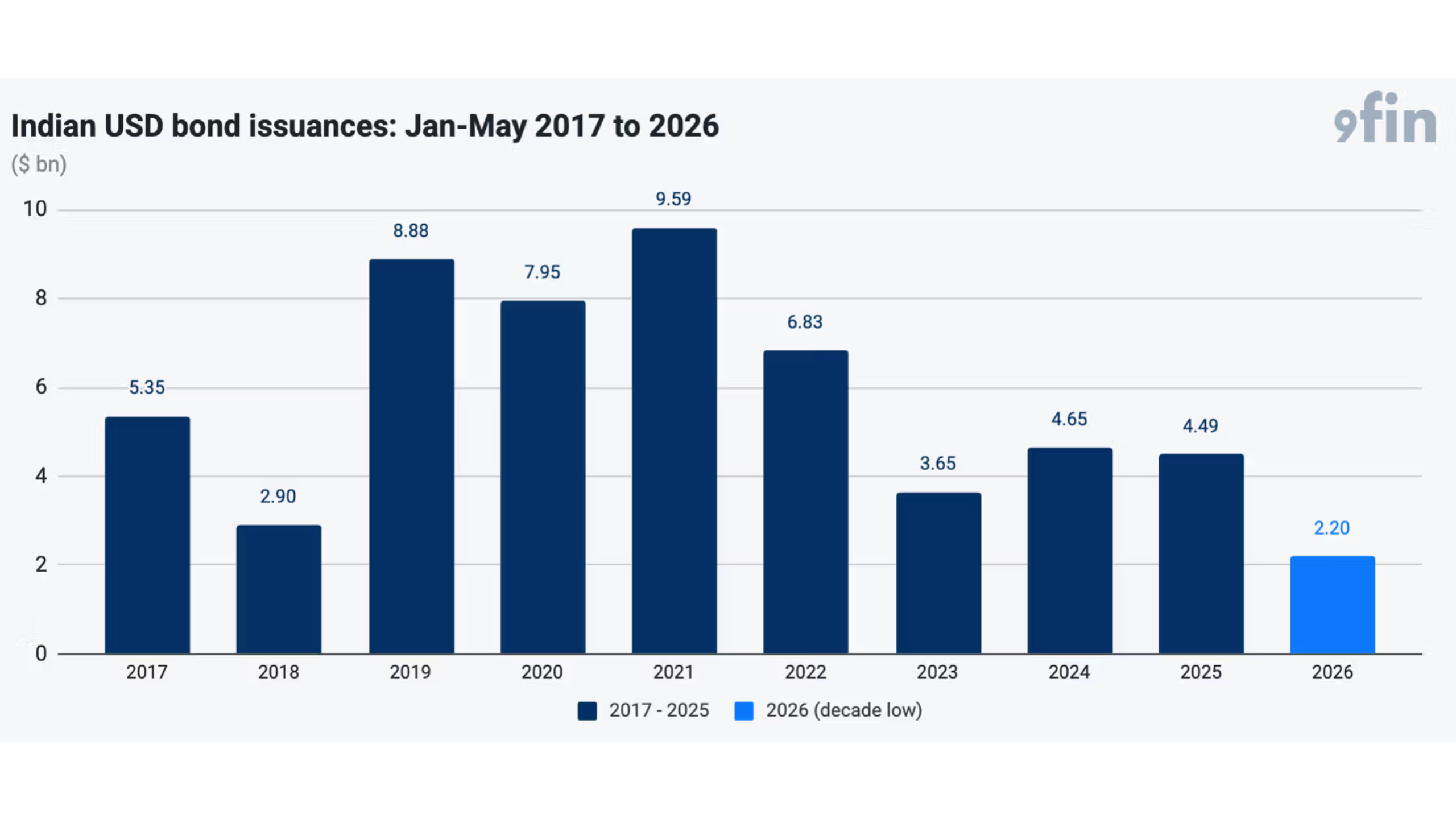
Indian companies are sharply reducing offshore borrowing activity in 2026 as elevated hedging costs and higher global interest rates make US dollar-denominated debt increasingly expensive.
According to data from 9fin, Indian issuers raised just $2.2 billion through dollar bond sales during the first five months of the year, down from $4.49 billion during the same period in 2025.
The decline marks the weakest start to the year for India’s offshore bond market in at least a decade and represents a sharp reversal from 2021, when Indian corporates raised nearly $9.6 billion across nineteen international bond transactions during the January-to-May period.
Market participants point to rising currency hedging costs as one of the primary drivers behind the slowdown.
As the Reserve Bank of India continues efforts to stabilize the rupee, hedging costs for dollar-denominated borrowing have climbed into the 3% – 4% range, materially reducing the funding advantage traditionally associated with offshore issuance.
At the same time, elevated US Treasury yields and wider credit spreads have increased borrowing costs across global debt markets, particularly for emerging-market issuers.
The deteriorating economics are pushing several Indian corporates to reconsider international financing plans.
Companies including IIFL Finance and Capri Global have reportedly delayed or reconsidered offshore issuance activity, while refinancing conditions remain challenging for highly leveraged groups seeking maturity extensions.
Analysts say the slowdown reflects unfavorable funding economics rather than weakening credit quality among Indian issuers.
As a result, many corporates are increasingly turning toward domestic capital markets, where financing conditions are currently viewed as more stable and less exposed to foreign exchange volatility.
The shift highlights broader pressure facing emerging-market borrowers globally as higher interest rates, tighter liquidity, and volatile currency markets reshape international funding strategies.
Bankers and debt market analysts believe a sustained recovery in India’s offshore issuance activity would likely require lower US interest rates, reduced hedging costs, narrower credit spreads, and greater stability in the rupee.