The global financial system is entering a new phase one defined not by experimentation, but by execution. Stablecoins, once viewed as speculative instruments, are rapidly becoming the foundational infrastructure of modern payments. Wirex, a long-standing player in the digital asset space, has delivered one of the clearest signals of this transition.
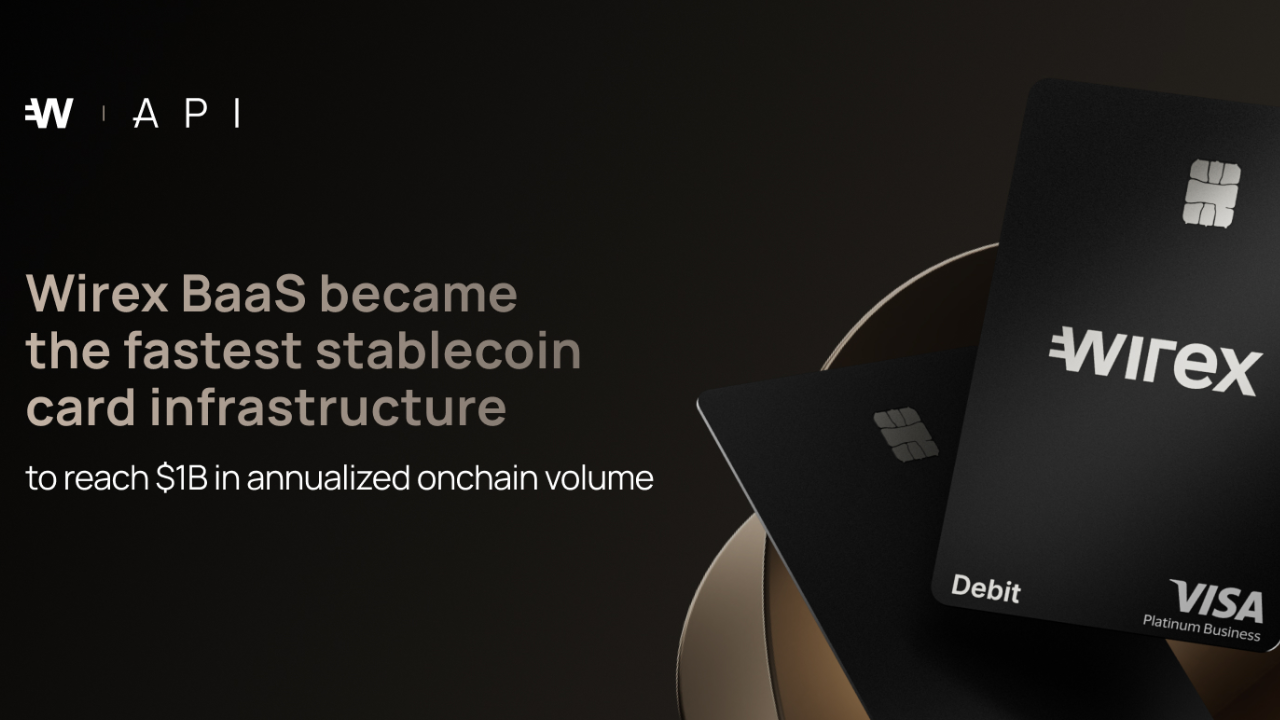
Following the launch of its Banking-as-a-Service (BaaS) platform in November 2025, the company reached $1 billion in annualized on-chain stablecoin volume in just 131 days. For context, the previous benchmark set by RedotPay, required 276 days to achieve the same milestone. Wirex has effectively redefined the speed at which financial infrastructure can scale.
This level of growth is not simply a reflection of internal momentum. It highlights a broader structural shift across the industry, where stablecoins are no longer treated as experimental tools, but as operational rails for global commerce. Performance data from March 2026 illustrates the velocity of this adoption. During the month alone, Wirex processed $105 million in on-chain card volume, placing the platform on a trajectory toward approximately $1.3 billion in annualized throughput. At the same time, total transaction count has exceeded 2.4 million since launch, with more than 1.3 million transactions recorded in March alone.
This surge demonstrates not only demand, but system resilience. The platform has proven its ability to handle high-volume, real-world usage without degradation in performance an essential requirement for infrastructure at global scale. Transparency has also emerged as a defining differentiator. In contrast to traditional financial systems, where transaction visibility is often limited, Wirex provides full on-chain verification through its Payment Scan system. This ensures that all transaction activity is publicly auditable, reinforcing trust among partners and users in an environment where verification is increasingly critical. The company’s strategic position is further strengthened by its regulatory and network access. Wirex is currently the only stablecoin-focused BaaS provider with principal membership in both Visa and Mastercard. This enables seamless dual settlement in both USDC and EURC, effectively bridging traditional card networks with blockchain-based value transfer.
By offering a unified API that supports card issuance, real-time fiat-to-stablecoin conversion, cross-border payouts, and push-to-card functionality, Wirex removes the technical and regulatory complexity that would otherwise prevent most companies from entering the space. Speed of integration has become another key advantage. While building proprietary payment infrastructure can take years, Wirex reports an average partner integration time of just 44 days. For the more than 300 partners already leveraging the platform, this dramatically reduces time-to-market and allows for rapid deployment of new financial products. At the same time, the evolution of stablecoins is moving beyond the dominance of the U.S. dollar. Between 2023 and 2026, transfer volumes for non-USD stablecoins increased sixteenfold, driven primarily by real-world use cases such as payroll, B2B settlements, and consumer payments.
In regions across Europe and Asia, businesses are increasingly adopting local currency-pegged stablecoins such as EURC to reduce exposure to FX volatility and align more closely with regional financial ecosystems. Wirex has positioned itself at the center of this transition, enabling programmable payment logic that supports automated, transparent, and efficient financial operations.
As noted by Co-Founder Pavel Matveev, the objective is to provide a fast, trusted solution capable of scaling globally. The data suggests that this vision is already materializing, with Wirex emerging as a key infrastructure layer in the next generation of financial services.